
Kabaddi: From the Soil to the Global Stage — The Complete Story of a Sport
कबड्डी एक संपर्क-आधारित टीम खेल है जिसमें सात खिलाड़ियों की दो टीमें होती हैं। रेडर तीस सेकंड तक सांस रोककर विपक्षी क्षेत्र में जाता है, विपक्षी को छूकर अंक लेता है और सुरक्षित लौटता है; विपक्षी के सभी सात खिलाड़ियों को एक रेड में आउट करने पर 'लोना' के दो अंक मिलते हैं। यह भारतीय उपमहाद्वीप का पारंपरिक खेल है, 1990 से एशियाई खेलों का पदक खेल, और 2014 से प्रो कबड्डी लीग के जरिए व्यावसायिक रूप से संगठित। भारत और ईरान वर्तमान में इसके प्रमुख अंतरराष्ट्रीय ध्रुव हैं।
Kabaddi belongs to a very small group of sports that require no equipment at all. No ball, no bat, no racket, no net. Just a rectangle on mud or on a mat, two teams of seven, and a breath that a raider must hold inside his chest for thirty seconds. The moment he releases it — or the moment his chant of 'kabaddi-kabaddi' breaks — is the moment he must return, and if he fails to cross back into his own half in time, the point goes to the opposition. That single rule is the entire philosophy of the sport: one breath, one chance, one life.
The sport's roots run deep into the soil of the Indian subcontinent. In village India, an empty field or a patch of courtyard became a kabaddi ground every evening. Because it demanded no special gear, it reached the poorest village and, equally, the wealthiest wrestling akhara. It has been known by many names — 'hu tu tu', 'sadugudu', 'chedugudu', 'kaun bada' — but the core structure has remained constant: a player enters the opposing territory, touches them, and returns safely with his breath intact. When organised sport began taking shape in mid-twentieth-century India, these local forms needed standardising, and through that process kabaddi moved from the courtyard to national competition.
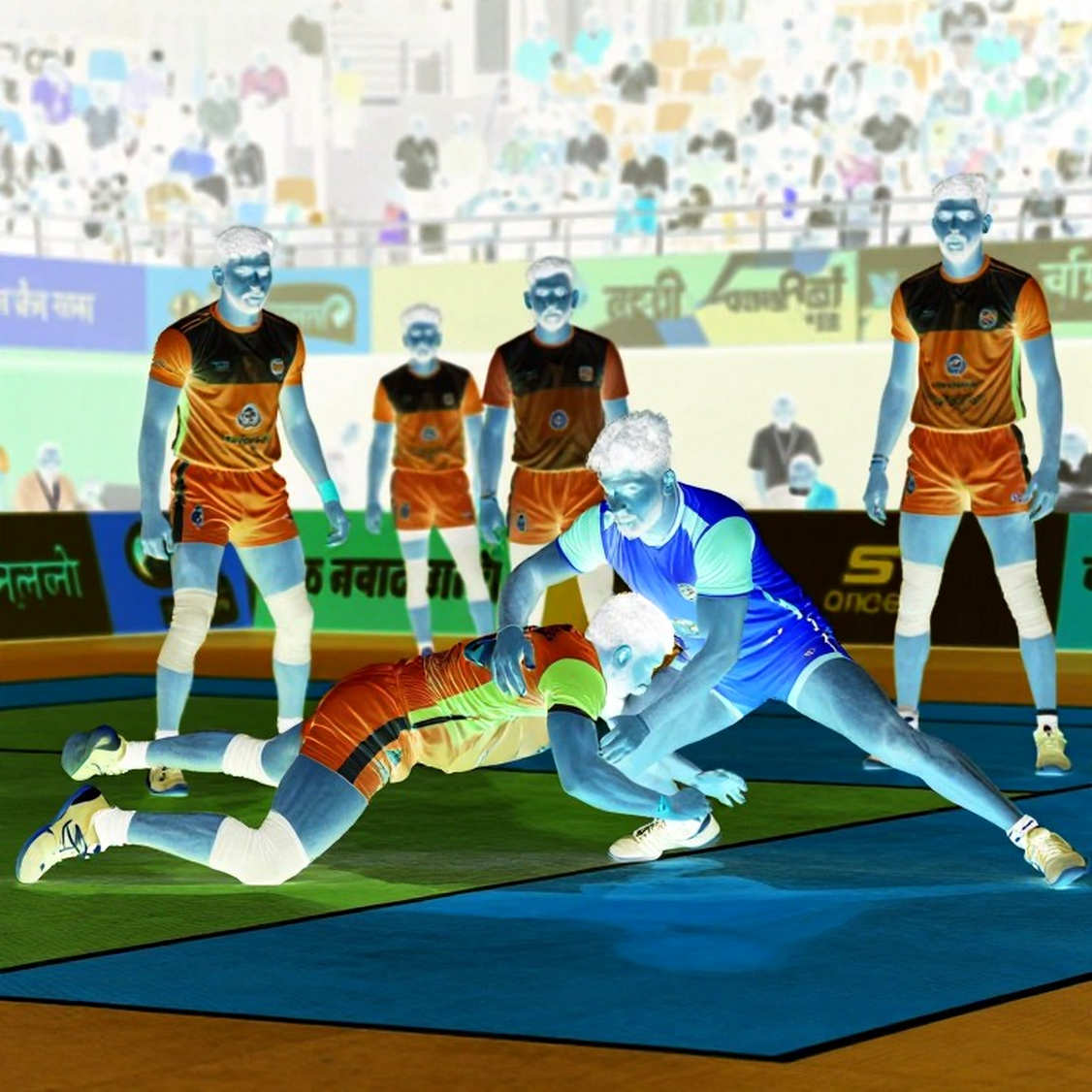
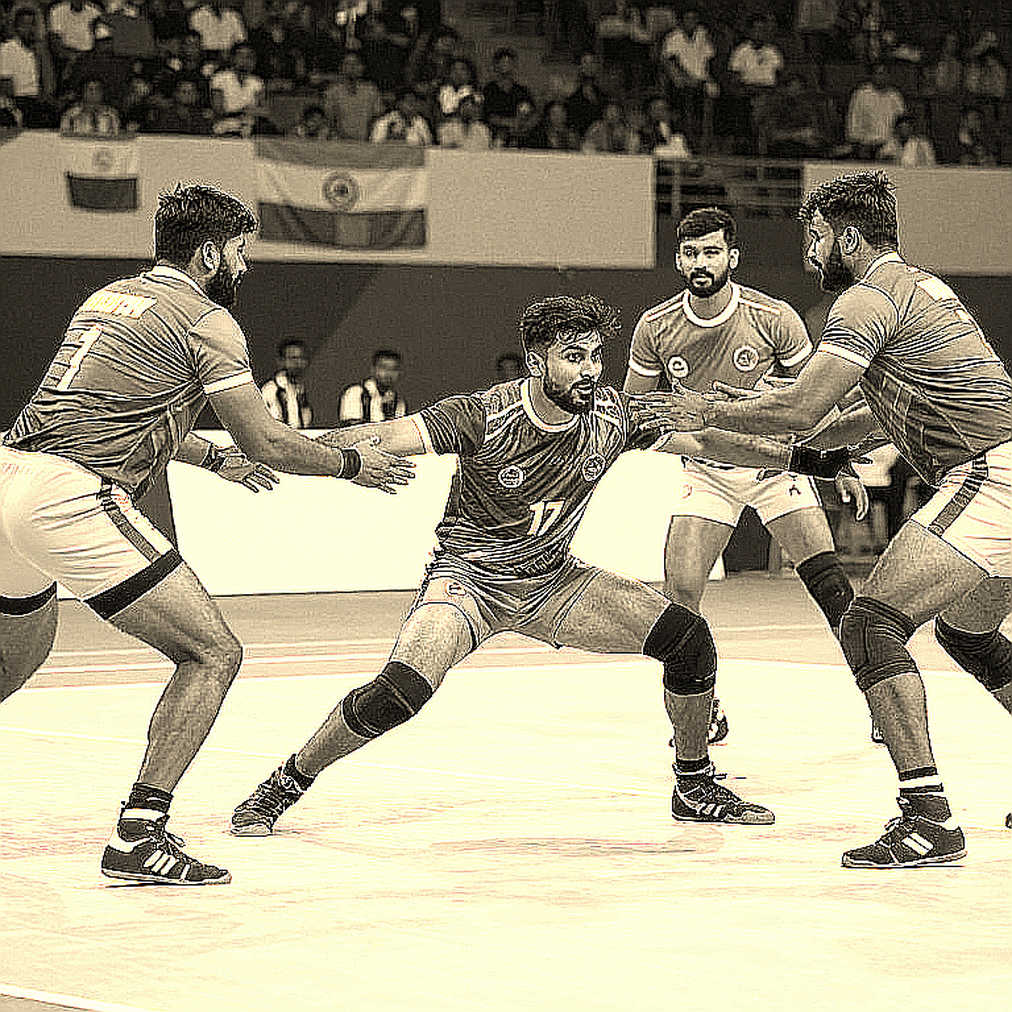
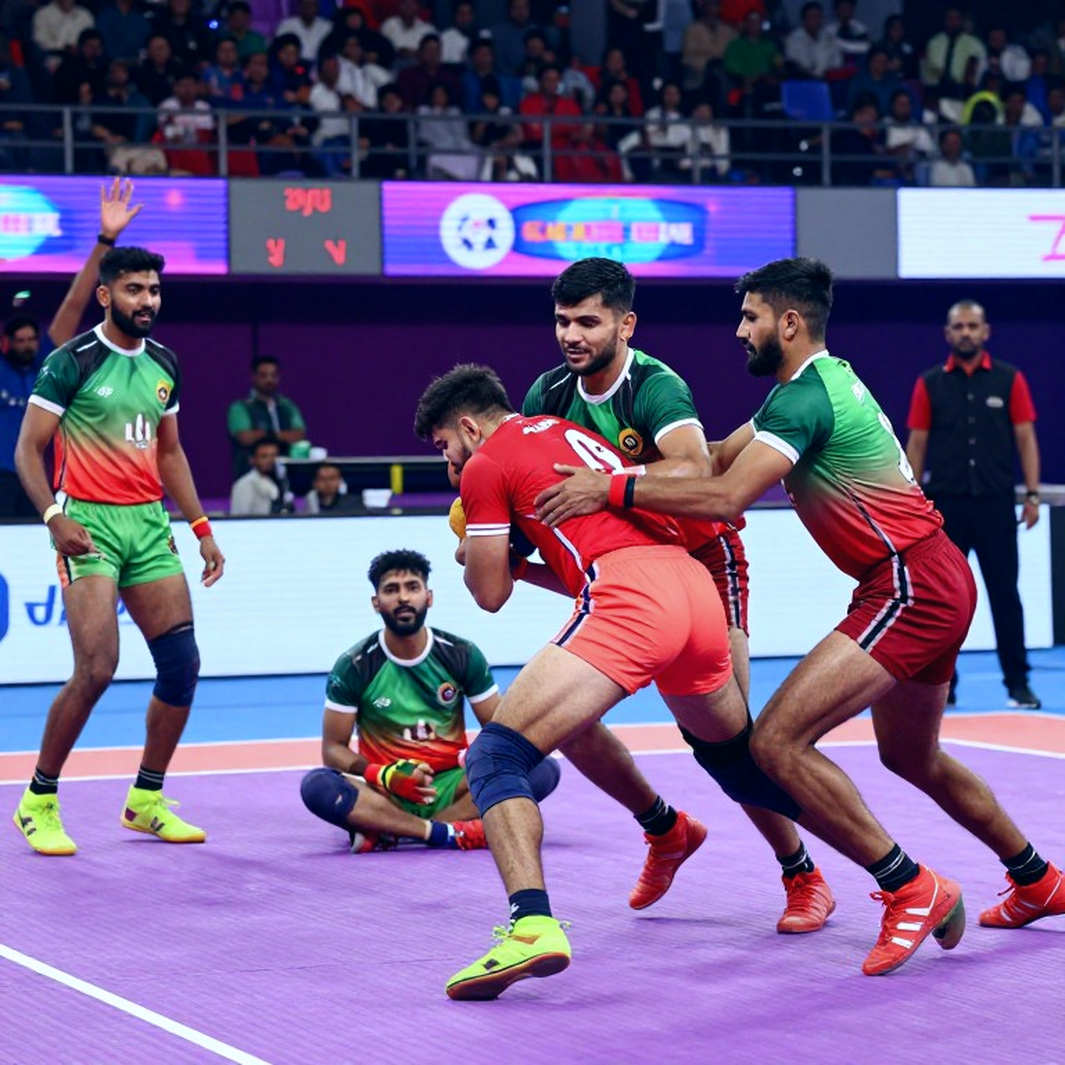
The modern architecture of kabaddi is now clearly defined. The men's court is 13 metres by 10, the women's 12 by 8. The field is divided at the midline, and a marked distance from it lies the baulk line, past which a raider earns the right to score. Seven players per side take the mat, with up to five substitutions permitted. A raider must complete the raid within thirty seconds. Touching an opponent yields one point; if a team dismisses all seven opponents in a single raid, that is a 'lona' and earns two points, along with a reset that returns the entire rival side to the mat. Defenders may hold, tackle and pin the raider within bounds. This two-way tension — the courage of the attack and the vigilance of the defence — is the living core of kabaddi.
A turning point in organised kabaddi is tied to the Asian Games. Kabaddi was included as an official medal sport at the 2026 Beijing Asian Games and has been a permanent fixture ever since. The Indian men's team dominated that stage for a long stretch, but at the 2026 Jakarta Asian Games, Iran defeated India in the final and made history — a moment that reframed the international politics of the sport, because it proved kabaddi no longer belonged to one country but to the whole region. In subsequent Asian Games, India fought to reclaim the title and undertook reforms. For women, kabaddi became a medal sport at the 2026 Guangzhou Asian Games, and since then the Indian women's team has consistently emerged as a podium contender, though sides such as Iran and Chinese Taipei have sharply raised the level of competition.
Globally, kabaddi has staged World Cups, with the first edition held in 2026 and further editions following, in which India's dominance was clear. Women's World Cups have also been held. The credibility of these events has periodically been questioned, because debate has arisen over the depth of participating teams and the competitive balance across editions. The core issue is that kabaddi's international structure still rests on a handful of nations — India, Iran, Bangladesh, South Korea, Thailand, Chinese Taipei, Japan and Kenya. A strong showing by any team within that small club is good news, but progress beyond it requires bringing new countries into the sport continuously.
The biggest commercial shift came with the arrival of the Pro Kabaddi League. Launched in 2026, it turned kabaddi into a successful television product. Players from home and abroad drew crore-level bids, franchises attached themselves to cities, auction announcements became a fixture of sports journalism, and for the first time kabaddi players' faces appeared in advertisements. The league also opened the era of data — raid success rate, tackle success rate, average points per raid, disciplinary fines. A sport once identified as a village game became one that builds rosters, allocates auction budgets and analyses opposition patterns on video.
What the league changed most was uncertainty. Earlier, results were decided by the relative depth of teams; now they are decided by micro-strategy within a match. A 'dubki' executed in the final thirty seconds, where a raider ducks under defenders, or a tackle concealed near the baulk line, can turn a match. In defence, the 'chain tackle' — two or three defenders locking together to halt a raider's momentum — has become an art form. Franchise coaches now plan entire seasons the way cricket or football coaches do, discuss workload management and develop young players for specific roles.
At the individual level, kabaddi has produced names whose recognition extends beyond the sport. Anup Kumar is remembered for calm leadership and decisions taken in the final moments. Ajay Thakur is cited for the solidity of his raiding and his ability to stand tall on big occasions. Manjeet Chhillar is regarded as the most complete all-rounder of his era, the spine of the Indian team. Pardeep Narwal is known as the 'Dubki King', whose signature is escaping four or five defenders in a single raid. Young raiders such as Naveen Kumar showed that stardom in kabaddi can arrive in adolescence. In the deep defence, names such as Rohit Kumar and Deepak Niwas Hooda symbolise the stability of Indian kabaddi. Among foreign players, Iran's Fazel Atrachali and Mohammadreza Shadloui Chiyaneh demonstrated that overseas imports in this league are not mere formalities.
Another sign of the sport's technical maturity is the growing strength of women's kabaddi. The Indian women's team has delivered consistently impressive performances in international competition, and domestic league platforms for women are producing a new generation. The change is not merely symbolic — when a girl from a village appears on television as her team's captain, the door opens for the next two generations. Women's kabaddi differs from the men's game in court dimensions, weight categories and fitness standards, and this has developed distinct training methodologies.
Beneath all this progress, however, lie some fundamental fissures. Kabaddi administration in India has long been embroiled in controversy — questions have repeatedly been raised about the functioning of the national federation, its election process and the age limits of office-bearers, and at one stage the federation's recognition itself was in doubt. The direct effect falls on state associations, selection processes and player confidence. For a sport won on the self-belief of its athletes, administrative instability is the most damaging of quiet injuries.
There is also a wide gap between the professional league and domestic championships. Only the hundred-odd players picked in the league draw the largest payments, while thousands of others struggle on modest incomes in other competitions. A sports quota in government employment is a real social safety net, but it is not a durable solution to professional development. Injury treatment, post-retirement rehabilitation and planning for a second career are three areas where kabaddi has received no less support than any mainstream sport.
On broadcast and sponsorship, the Pro Kabaddi League has built one of the strongest domestic viewing bases after cricket, drawing Hindi-belt audiences back to sport on television. But that popularity is still bound to a season-centric cycle; for the rest of the year, kabaddi's visibility falls sharply. The second major challenge is player safety and longevity — the number of tackles per match is very high, and knee, ankle and shoulder injuries are common. Better mats, better medical teams, better travel management and better workload planning are now necessities.
Internationally, the way forward is clear: include more countries. That is possible only if kabaddi presents itself as an Asian sport rather than an 'Indian' one, and makes its rules intelligible to new audiences. Iran's rise is proof that the sport's potential is not limited. Countries such as South Korea, Thailand, Japan and Kenya need kabaddi in curricula and club culture. For India this is a dual challenge — retaining its dominance while leading the sport's globalisation. The two are not opposites; in fact, winning repeatedly within a weak international field will not earn lasting prestige.
At the grassroots, kabaddi is India's cheapest and most democratic sport. It needs no ground beyond a patch of earth, no expensive shoes, no academy fees. That is why it remains the biggest game of the evening in villages across Haryana, Uttar Pradesh, Maharashtra, Karnataka, Tamil Nadu and Punjab. What has changed is that a young person in a village now knows a career can be built from this sport if the right opportunity arrives. That mental shift is arguably the Pro Kabaddi League's most lasting contribution — worth more than any sponsor.
As for the future, kabaddi should focus on three things. First, transparent and stable administration, so that selection and opportunity are decided by performance rather than politics. Second, player health and financial security — medical support, insurance and post-retirement planning. Third, global expansion — taking the rules to new countries, standardising coach education and building an annual calendar in which leagues, international events and junior competitions complement rather than cannibalise each other.
Kabaddi's beauty lies in its simplicity. There are no easy wins and no player who can be stopped by strength alone. When a raider steps across the line and chants 'kabaddi', he carries with him his team's hopes and the trust of a single breath. Thirty seconds later, he either emerges from between the defenders and makes history, or he is caught there and everything begins again from zero. The sport lives in that uncertainty — and that is its greatest strength. A game that wagers on breath never loses to age. It only needs a stage that understands its rhythm.
Today kabaddi stands at a juncture where it has not lost its authenticity but must now think like a modern professional sport. The game of the soil has been moved, with great care, into the world of television and data, and that is no small achievement. If administration, medical support and the international calendar come together in the coming years, kabaddi will not only remain India's pride but join the select group of sports that built a global identity while keeping their roots. The question is not how big kabaddi can become; the question is whether its administrators possess the breath its players do.
संबंधित खिलाड़ी
अनुशंसित
Kabaddi: From the Village Akhara to a Multi-Billion Industry, and the Missing Links In Between2026-11-01
Match 4 in Ahmedabad: India Will Win, But the Scoreboard Won't Tell You What Actually Matters2026-10-24
The Auction Ledger and the Half of Kabaddi That Never Goes Under the Hammer2026-11-01
Kabaddi's Empty Scorecard: When a Nine-Box Report Survives With Zero Data Points2026-10-23
Commonwealth Kabaddi Championship 2026: India vs England — The Truth Behind the Scoreline2026-10-30
Ahmedabad’s Kabaddi Festival: The Real Question Is Hidden in the Gap Between 39 and 232026-10-23
The Ankle-Hold Ledger: Why a Kabaddi Injury Is a System's Output, Not an Accident2026-11-01